
Result
The average carbon footprint of a person in Japan is said to be 7,000–7,500 kgCO2e per year (ref. 30, 31).
Your lifestyle carbon footprint is…
Reference Information
*1: The carbon footprint estimate provided by this tool is a guideline based on user input and general assumptions. Building structures and seasonal factors may cause variations, so please use this result as a reference for reviewing your sustainable lifestyle.
*2: There are areas not calculated by this tool (e.g., leisure, services, products). For those, the national average CO2emissions in Japan are used (ref. 30).
It's important to consider those emissions as well.
It's important to consider those emissions as well.
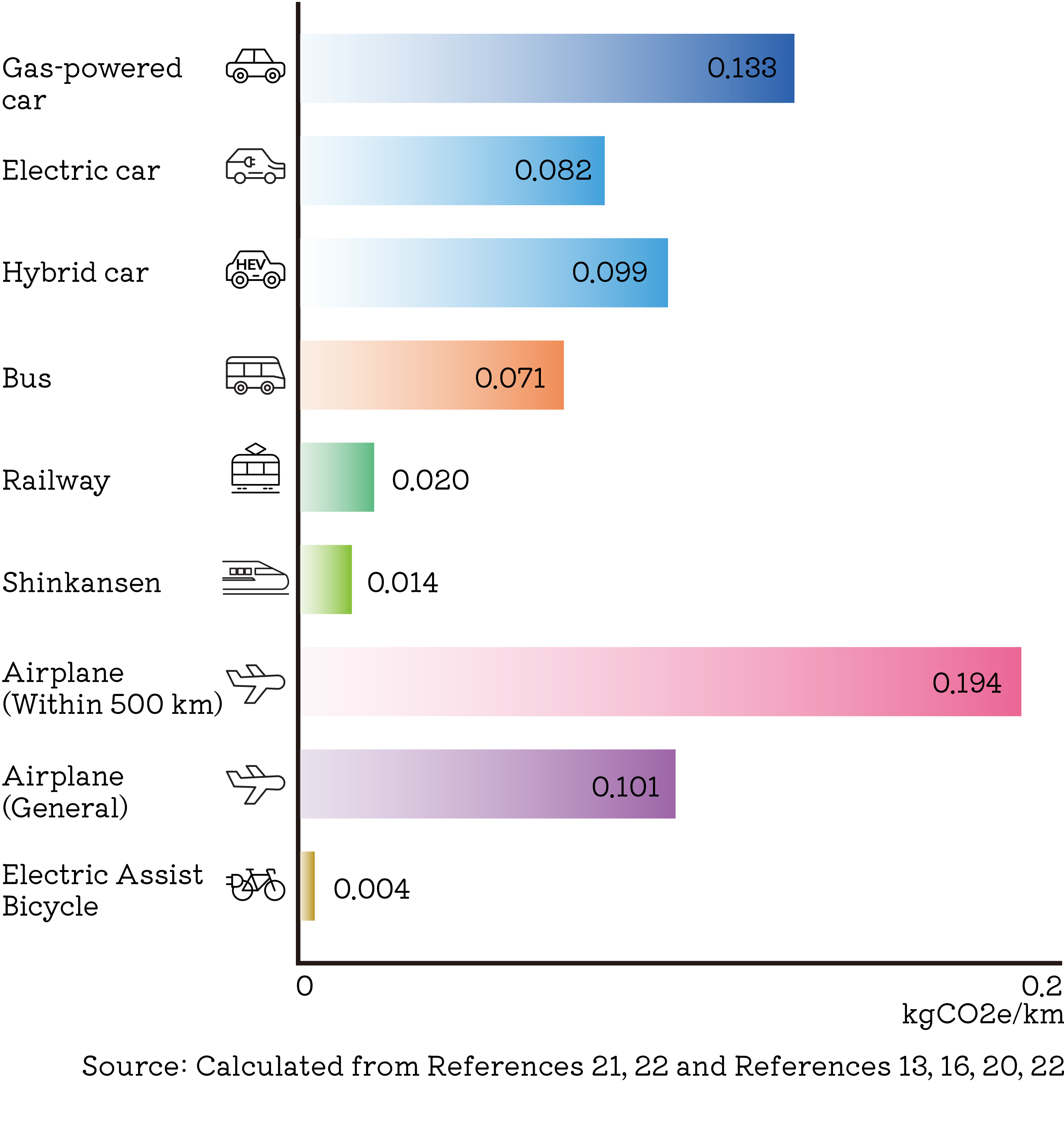
CO2 emissions from transportation
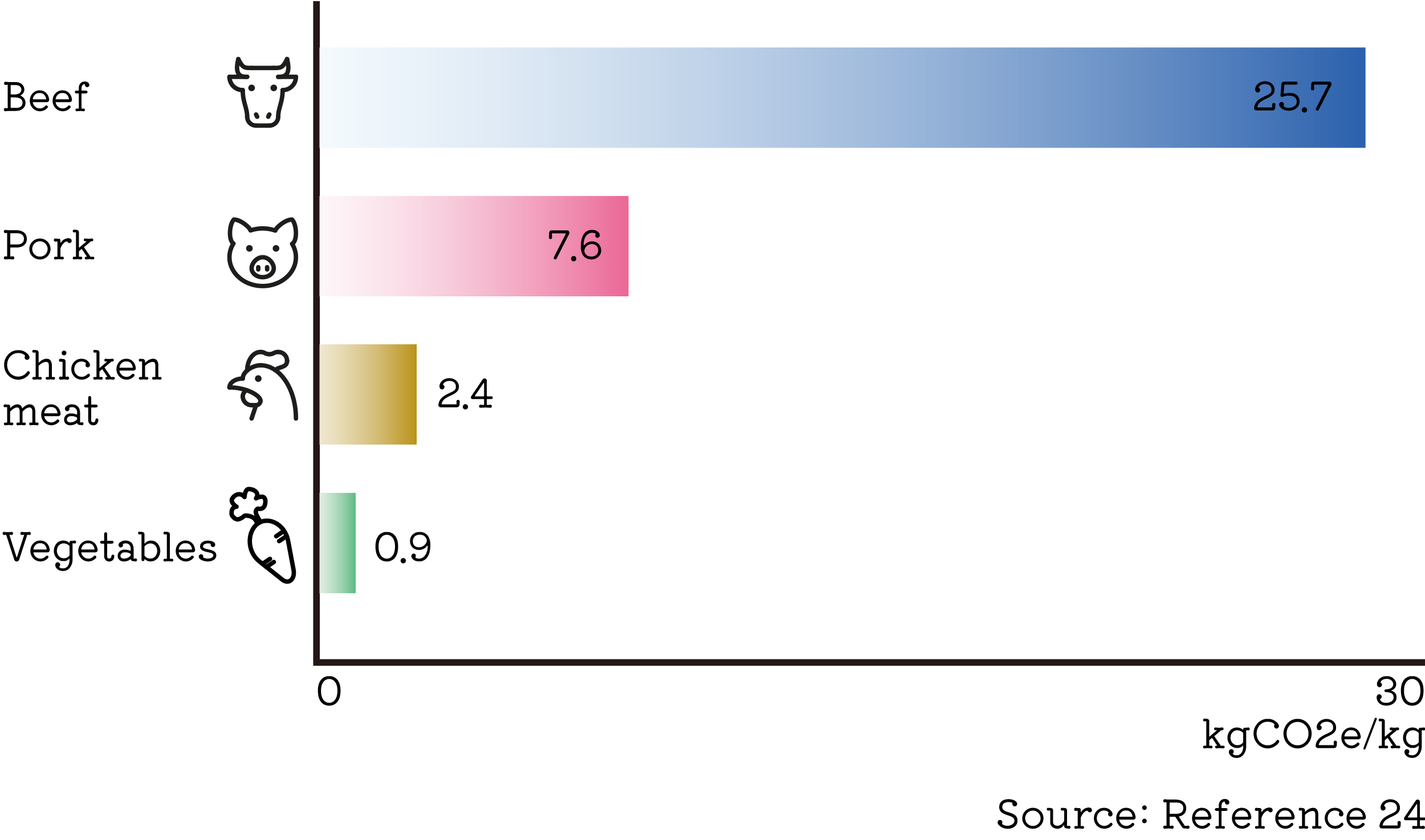
CO2emissions from meat and vegetables
References
- 北海道電力HP(2024年9月12日時点) ▶ 単価表 ▶ 2022年度CO2排出係数
- 東北電力HP(2024年9月12日時点) ▶ 単価表 ▶ 2022年度CO2排出係数
- 東京電力HP(2024年9月12日時点) ▶ 単価表 ▶ 2022年度CO2排出係数
- 北陸電力HP(2024年9月12日時点) ▶ 単価表 ▶ 2022年度CO2排出係数
- 中部電力HP(2024年9月12日時点) ▶ 単価表 ▶ 2022年度CO2排出係数
- 関西電力HP(2024年9月12日時点) ▶ 単価表 ▶ 2022年度CO2排出係数
- 中国電力HP(2024年9月12日時点) ▶ 単価表 ▶ 2022年度CO2排出係数
- 四国電力HP(2024年9月12日時点) ▶ 単価表 ▶ 2022年度CO2排出係数
- 九州電力HP(2024年9月12日時点) ▶ 単価表 ▶ 2022年度CO2排出係数
- 沖縄電力HP(2024年9月12日時点) ▶ 単価表 ▶ 2022年度CO2排出係数
- 総務省統計局「家計調査2023年」
- 環境省「家庭部門のCO2排出実態統計調査 令和4年度」
- 環境省「算定方法・排出係数一覧」(令和5年12月12日更新(令和6年7月11日 p.19を一部修正)版)
- 資源エネルギー庁「ガス事業生産動態統計調査 2023年1月~12月」
- エルピーガス振興センター「石油ガス流通実態調査」2023年2月
- 日本LPガス協会「燃料の発熱量・CO2排出係数の一覧表」 2024年6月6日
- 環境省「ガス事業者別排出係数一覧」(2024年9月11日時点)
- 日本エネルギー経済研究所石油情報センター「平成18年度灯油消費実態調査」平成20年3月
- 国道交通省『「使える」ハイウェイ政策の推進に向けて』平成17年2月
- JR東海「中央新幹線(東京都・名古屋市間)環境影響評価書」平成26年8月
- 国道交通省「運輸部門における二酸化炭素排出量」2022年度令和6年4月26日更新
- European Environment Agency. "Monitoring of CO2 emissions from passenger cars, 2022 - Final data"(2024年9月11日アクセス)
- 厚生労働省「国民健康・栄養調査」令和元年
- Sugimoto et al, "Diet-related greenhouse gas emissions and major food contributors among Japanese adults:comparison of different calculation methods".
Public Health Nutr: 24(5), 973–983, 2021
doi:10.1017/S1368980019004750 - Nomura et al, "Current dietary intake of the Japanese population in reference to the planetary health diet-preliminary assessment".
Frontiers in Nutrition: 10:1116105, 2023
doi:10.3389/fnut.2023.1116105 - Roy et al, "Life cycle of meats: An opportunity to abate the greenhouse gas emission from meat industry in Japan".
Journal of Environmental Management: 93 (1), 218-224, 2012
doi:10.1016/j.jenvman.2011.09.017 - Deriemaeker et al, "Nutrient Based Estimation of Acid-Base Balance in Vegetarians and Nonvegetarians".
Plant Foods Hum Nutr: 65:77–82, 2010
doi: 10.1007/s11130-009-0149-5 - Segovia-Siapco et al, "Beyond Meat: A Comparison of the Dietary Intakes of Vegetarian and Non-vegetarian Adolescents".
Frontiers in Nutrition: 6:86, 2019
doi: 10.3389/fnut.2019.00086 - Orlich et al, "Patterns of food consumption among vegetarians and non-vegetarians".
British Journal of Nutrition: 112, 1644–1653, 2014
doi:10.1017/S000711451400261X - 小出 瑠・小嶋 公史・南齋 規介・Michael Lettenmeier・浅川 賢司・劉 晨・村上 進亮(2021)
「 国内52都市における脱炭素型ライフスタイルの選択肢:カーボンフットプリントと削減効果データブック」 - Institute for Global Environmental Strategies, Aalto University, and D-mat ltd. 2019. "1.5-Degree Lifestyles: Targets and Options for Reducing Lifestyle Carbon Footprints"
Institute for Global Environmental Strategies, Hayama, Japan.
Technical Report ISBN 978-4-88788-220-1 - Institute for Global Environmental Strategies, Aalto University, and D-mat ltd. 2019. "1.5-Degree Lifestyles: Targets and Options for Reducing Lifestyle Carbon Footprints"
Institute for Global Environmental Strategies, Hayama, Japan.
Annexes to the Technical Report ISBN 978-4-88788-221-8 - 国立環境研究所「日本国温室効果ガスインベントリ報告書」2024年4月版(5月31日修正版)